This page contains information about the lifestyle lens implant options we offer for our patients diagnosed with cataracts. To learn more about cataracts, visit our cataracts overview page and visit Clear Vision for You.
Once you’ve made the decision to have cataract surgery, you still have a crucial choice ahead of you. During surgery, your eye’s cloudy natural lens will be replaced by an artificial intraocular lens (IOL). Not long ago, nearly everyone who had cataract surgery was fitted with the same basic type of IOL. However, recent innovations have led to the development of a variety of IOL designs, each with their own unique features and advancements.
Wearing reading glasses after cataract surgery is no longer the only option.
Dr. Ejaz Husain is qualified to implant a new generation of advanced technology lifestyle lenses that are specially designed to provide excellent vision at all distances, dramatically reducing or eliminating your need for glasses.
There are several available lifestyle lenses, and our surgeon offers a variety of options in order to provide you with the most appropriate treatment for your visual needs. Personalizing your procedure will lead to better results and more visual independence for you.
You and Dr. Husain will work together to decide which type of IOL is best suited for your needs. And while the characteristics of your eyes certainly play a critical role in lens selection, it’s just as important to consider your lifestyle, and the role vision plays in the activities you enjoy.
Would you like the chance to be glasses-free after surgery, or are you fine with wearing glasses? Do you have astigmatism? Is cost an issue? These are the sort of questions you’ll need to consider as you begin thinking about IOL options.
While a lifestyle lens is usually implanted during cataract surgery to replace a clouded lens, they are sometimes used to alleviate the need for reading glasses in patients who do not yet have cataracts. These patients will never face cataract surgery because, unlike the eye’s natural lens, a lifestyle lens will never develop a cataract.
So, talk to your doctor, consider the options, and choose wisely – the IOL you select will change the very way you see the world!
Odyssey and Symfony Lenses: Advanced Technology Lifestyle Lenses
Cataracts are a common condition with almost 4 million cataract surgeries performed each year in the United States. That number is expected to increase. By age 80, more than half of all Americans either have a cataract or have had cataract surgery. However, cataracts do not just impact seniors.
In 2016, it was estimated that nearly one in four cataract surgeries was performed on people younger than 65. Many people who have cataracts experience other problems with their vision, such as presbyopia and astigmatism, which the TECNIS Odyssey™ and Symfony™ lenses also address. Presbyopia, which affects most people over age 40, involves the loss of the ability to focus on objects up close and often requires reading glasses to perform near visual tasks.
The recently FDA approved TECNIS Odyssey™ Intraocular Lens (IOL) provides a full range of vision — near, intermediate, and far — so you can have freedom to perform different activities throughout the day and night. If you have astigmatism, you also may be able to consider cataract surgery with the TECNIS Odyssey™ Toric II lens implant.
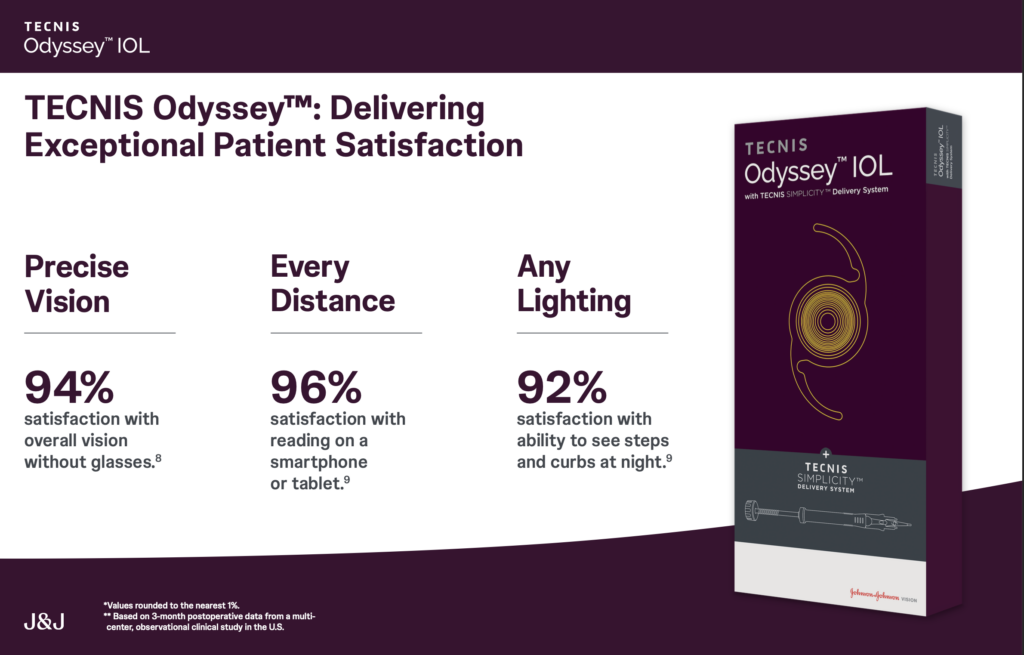
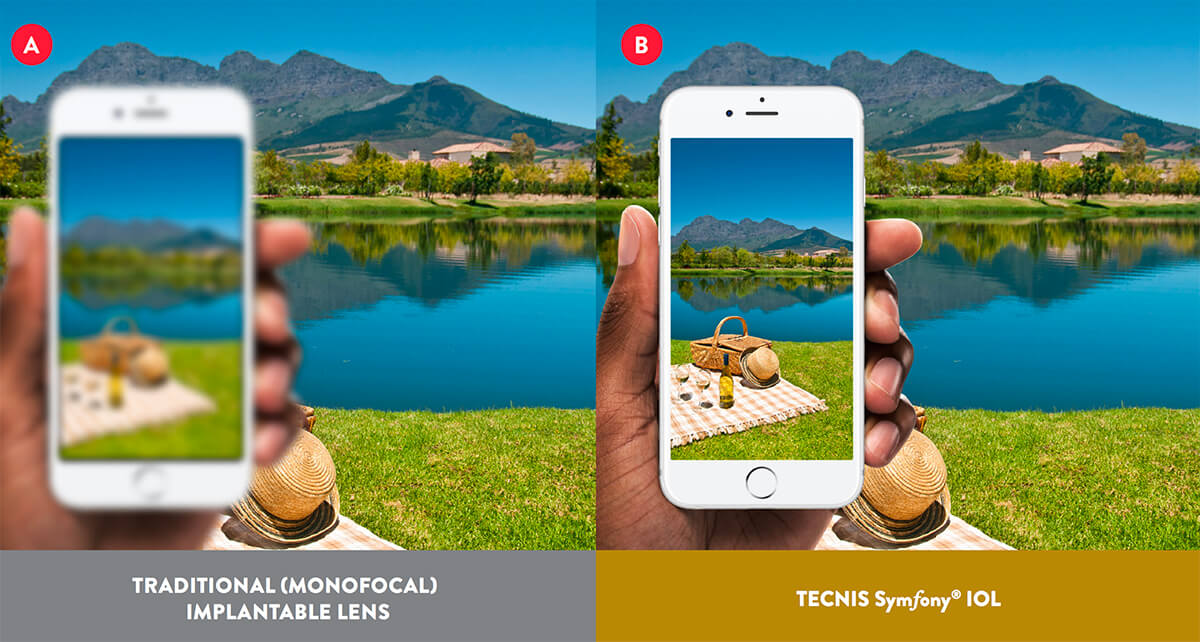
The FDA approval of the TECNIS advanced technology lenses is great news for people with cataracts and have trouble reading or focusing on close objects (presbyopia/far-sighted). The Odyssey™ and Symfony™ lenses have an extended range of vision IOL to correct presbyopia and improve vision in people with cataracts, as well as improving far, intermediate, and near vision, with the decreased need for glasses or contact lens after cataract surgery.
Understanding Your IOL Options
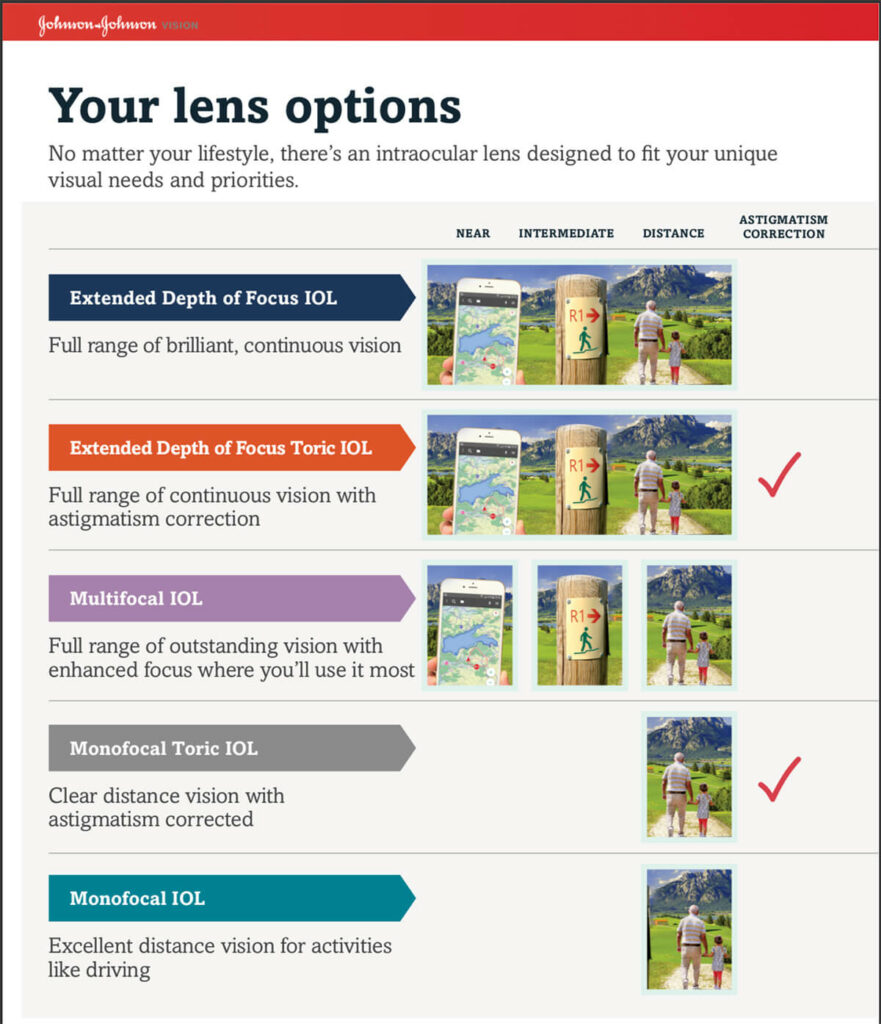
The Odyssey and Symfony lenses provide:
- Seamless, day-to-night vision. Patients could see objects sharply and clearly at near, intermediate and far away distances, and points in between.
- High-quality vision. Some IOLs may leave patients with an inability to focus clearly due to competing wavelengths of light passing through the lens at different angles (known as chromatic aberration), or with vision that is not completely focused because of the shape of the lens (known as spherical aberration). Both lenses have been engineered to correct these issues.
- A low demonstrated incidence of halo and glare, which may be perceived as rings or blurring around bright lights. Glare and halo can sometimes affect an individual’s ability to drive at night or to perform other visual tasks.
- Corrections for astigmatism with the TECNIS Odyssey™ and Symfony™ Toric lenses.
Toric Lifestyle Lens
Astigmatism Correcting Toric Implant
For cataract patients with astigmatism, successful cataract surgery is only half the battle for regaining quality vision. Astigmatism is a lengthy word with a simple explanation: the shape of your eye is more oblong than circular, which prevents you from focusing properly. Astigmatism often causes blurry or double vision. Most people are born with some degree of astigmatism but it does affect some more than others. Nearly 40% of people with cataracts also require astigmatism correction. If you have both astigmatism and cataracts, you may have the opportunity to address them simultaneously with a toric intraocular lens.
We believe that for the appropriate patient with astigmatism and cataract, the Toric lens can enhance their quality of vision and improve their quality of life. After all, you will have cataract surgery only once in your lifetime and fixing both the cataract and astigmatism during the same procedure will enhance your quality of vision forever. Numerous patients have taken advantage of this lens to decrease their dependence on glasses for distance after cataract surgery.

Your vision with astigmatism.

Your vision with a Toric astigmatism-correcting lens.